Our neighbour, Mr. Benson, retired last year so he could spend all his time at the lake house. To make the most of every day, he starts with a swim at 5 am, setting out for the far shore with strong regular, over-arm strokes, towing a red marker-float on a short rope, parting the inches thick mist that hugs the grey surface of the water and scattering the black silhouettes of mallards on the way.
The ducks make for the shore at first light to have a preen and look for acorns under the overhanging oaks until Mr Benson returns.
It's good to be the first person out there because by 6 am the first sport-fishing boats will be leaving the public launch ramp and revving their engines. Keen kayak fishermen will be already afloat, probing the shoreline for large-mouth bass that come to the shallows to hunt in the early light. The aluminium bass boats follow them round, passing only yards from our dock, using silent electric motors that are front mounted to make a stealthy approach that isn't possible with a 120 hp outboard engine.
 As the sunlight warms the trees, the small birds start their day. It's fun to sit on the dock with your back to the lake watching the cedar waxwings fly-catch over the water. They are soon joined by small flocks of tree swallows, a pair of black and white kingbirds and a pair of eastern phoebes, all of them aerial hunters of insects. A male bluebird with an orange breast calls from the very top of our tree. They are more like our English robins than the American robin, which is really a kind of blackbird.
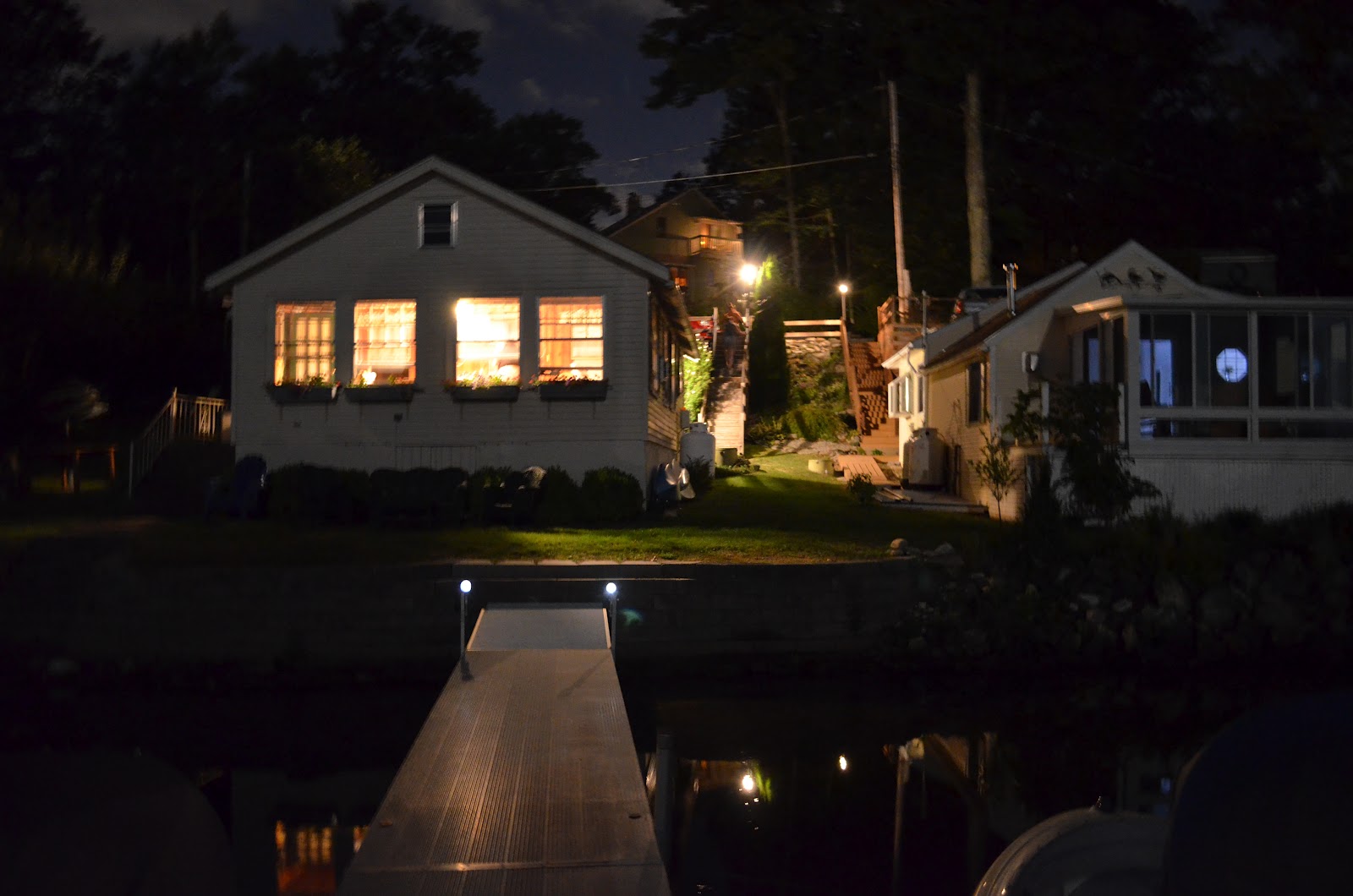
The lake is surrounded by cabins, many of which are used as holiday or week-end retreats, but an increasing number are lived in year-round. It's the year-rounders who regularly fill their bird feeders and so attract a lot of "garden" wildlife.
Hummingbirds need to eat as soon as it is light and then in frequent short bursts during the day. We have a special feeder for them, but they ignore it and feed from the touch-me-not balsams along the shore.

Blue jays are noisy and sociable. Their arrival scatters the sparrows and gold finches from the feeding station and they fly to the trees to mix with white breasted nuthatches, chickadees, tufted titmice and woodpeckers. High up in the canopy, passing warblers and vireos glean insects from the undersides of the leaves in our red-oak. A belted kingfisher, as big as a pigeon, rattles past our dock and hovers over the promontory at the end of our bay.
There is a public beach on the lake where early rising pensioners go to do their exercise drill in unison and then swim to the big-band sounds of their youth coming over the tannoy. I can see rubber swimming caps and goggles bouncing along in the roped-off area across the bay.
Chipmunks are late risers but when they get moving they are comically hyperactive, twitching nervously, stuffing their pouches and bouncing on all fours across the lawn. It's time to stock the larder for winter so over a couple of days they take kilos of expensive bird food down into their burrows. Their chip-chip alarm calls alerts me to a hawk overhead.
The State Trooper comes by with his boat on a trailer. He patrols the lakes in the area, looking for fishermen who have no permit, unregistered boats, people using alcoholic liquor, being rowdy or breaking the law in other ways. He gives me a stern look as he boats by, but I'm just bird-watching. I don't think I need a permit for that.
The air is beginning to move enough for the big soaring birds to come by. A bald eagle planks its way across the sky, glancing down at us with no real interest. A fish laden osprey yelps repeatedly to its unseen offspring. Later a pair of turkey vultures wobble their up-tilted wings as they adjust to every innuendo in the rising breeze. When they are not carrying any food, they seem to have too much wing and not enough weight, which makes them look unstable, like a sailboat with too much sail.
It's getting hot and humid now and there are big cauliflower clouds reflected in the water. Hot gusts of wind scatter silver-dust ripples across the lake. My ears hunt for sounds and I'm almost deafened by the constant background of crickets chirping and cicadas sawing. Normally my brain filters the sound of insects out but in the heavy, oppressive stillness before the storm, they sound threatening.
The birds almost all disappear by brunch-time as the sun gets too bright and the air gets too warm. Our cabin becomes a hot-house and we leave the lake for a while to eat at Mary-Anne's 1950s Diner which has air conditioning.
 At noon there is an impressively violent thunderstorm with gusts of wind, hail and heavy rain. Everyone and everything leaves the lake. Then it's all over. The sun pushes through and the puddles vaporise before our eyes. The insects start up again, louder than before and the garden shrubs are visited by dozens of huge monarch butterflies that are on their way from Canada to Mexico. They are surprisingly aggressive, bumping other insects off their chosen patch. All the same, a few other conspicuous species manage to get by them, including great spangled fritillaries, painted ladies and American white admirals. Two kinds of sphinx moth hover over the budleigha flowers, one imitating a wasp and the other a bee. Afternoon seems to be the best time for big insects such as gigantic yellow-and-black bees and huge black wasps and there are are dozens of them to see.
The serious ladies' kayak club appears every day around four o'clock. They paddle by in a strung out convoy, each locked in silence behind dark glasses. My greetings are not returned. One of them has her black dog tucked in the cockpit with her.
Bill-next-door takes his three grand-children out in his pontoon boat for a spin. They chat, scream and giggle joyously. A few fishermen come back for a second session, but after tea the lake gets really busy with water skiers, jet-boaters and party people. The gutsy smells of petrol and grilling barbecues invade the cabin.
In the fading light, nighthawks drift back and forth across the open ground near the public beach, plucking moths from the sky. Their southward migration south has only just begun and we see more of them each day.

It's family time now. Lights appear from the cabins and docks around the lake before sunset. There is a narrow window of opportunity to eat outdoors in the evening air before the mosquitoes become too fierce and most people seem to take advantage of it.
Just after dark, every ten minutes, I patrol the garden with my son to look for Tinker-Belles (fireflies) in the darkest corners of the shrubbery. We pause to stare at the millions of stars above, but are driven indoors by the mossies. Later we lie in bed, listening to the gentle splop of tiny waves that bump our aluminium canoe against the dock.
There are beavers out there in the dark, but they stay away from the cabins until the lake is frozen over and only a few year-rounders are left to see them, but as dawn approaches again I spot a pair of muskrats as black, mini-beaver silhouettes against the greyness of the water. They dive repeatedly for water plants that grow prolifically in the shallows near the shore. I put on a jug of coffee and so begins another day at Beaver Lake.


